
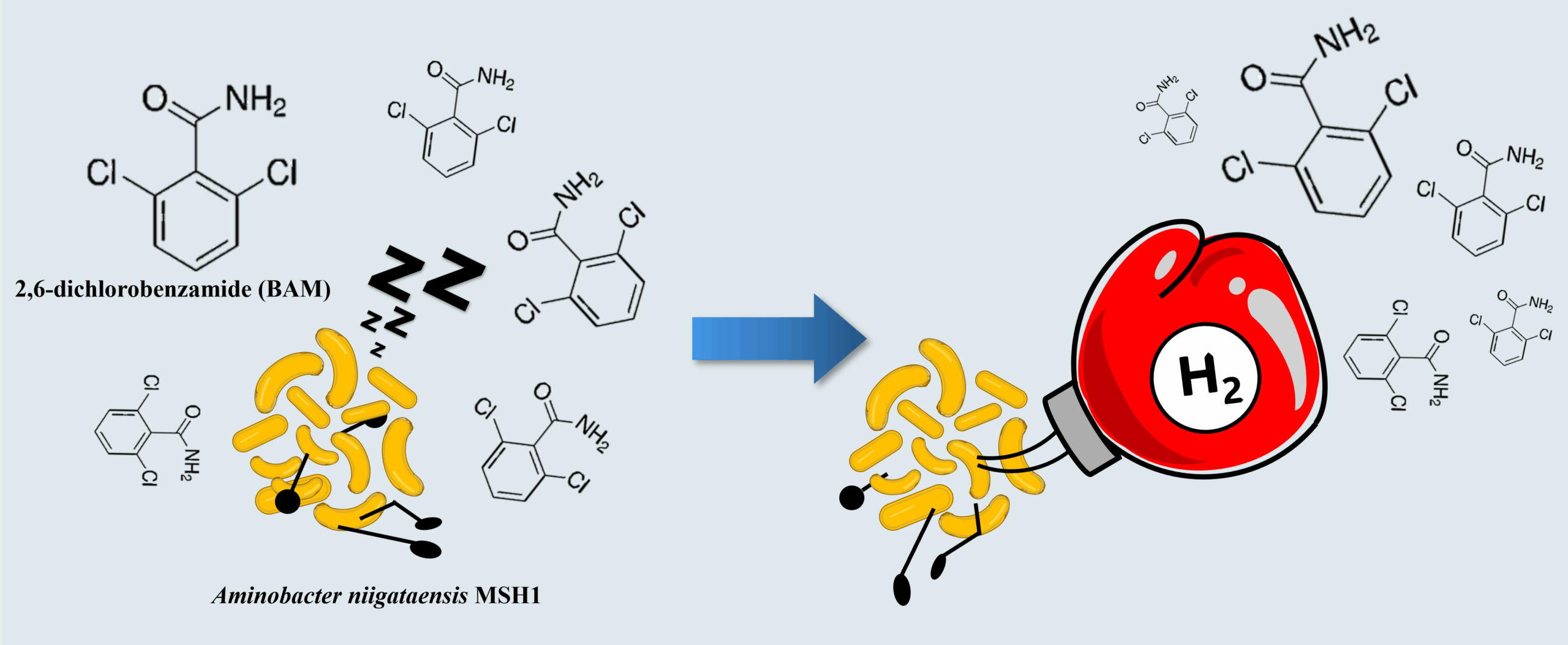
Organic micropollutants (OMPs) occur in natural aquatic environments at trace concentrations with suspected adverse effects on the ecosystem and human health. Microbial biodegradation plays a crucial role in OMP-elimination from drinking water resources. However, long-term OMP-biodegradation remains challenging since the metabolic activity of degrading strains is restricted by energy-limited conditions in treatment systems. Molecular hydrogen (H2) has been identified as a universally available energy source utilized by various bacteria under nutrient-starved conditions, and it can be hypothesized that H2 might also support OMP-degrading microbes when other energy carriers are scarce. A recent study conducted by PhD student Baiqing Liu, together with PhD student Wannes Nauwynck, Dr. Mingsheng Jia, and Dr. Kankana Kundu, led by Prof. Nico Boon, in collaboration with Prof. Dirk Springael and his team from Soil and Water Management, KU Leuven, tested the potential of H2 as a supporting energy source for OMP-degradation by examining its effect on the biodegradation of 2,6-dichlorobenzamide (BAM) by Aminobacter niigataensis MSH1 and on the physiological status of the MSH1 cells during both nongrowth-linked (500 μg BAM/L) and growth-linked (10000 μg BAM/L) regimes. The results show that H2 acts as an additional energy source for an organic micropollutant (OMP) degrader, thereby sustaining its metabolic activity and improving its performance in OMP biodegradation, particularly under starvation conditions.
In a metagenomic research on H2 as an essential energy source for microbial growth in 2016, the team of Prof. Chris Greening questioned in how the H2 metabolism would affect the wastewater treatment. Today, in CMET, our team answers!
Read the full paper here: https://doi.org/10.1016/j.watres.2025.124052