

The title of the doctoral dissertation is “The role and interactions of lactic acid and chain-elongating bacteria in granular bioprocesses for caproic acid production“
The public defence will take place on 30 October 2026 at 17:00 in the Room A0.1 Azalea at Campus Coupure, Coupure links 653, 9000 Ghent
A short abstract of the doctoral research
Much of what we discard still holds value. Food residues, agricultural by-products and wastewater all carry carbon that the circular bio-economy aims to convert into chemicals and materials. Within this concept, the carboxylate platform has emerged as a promising route, in which mixed microbial communities ferment complex waste into carboxylic acids. Among these, medium-chain carboxylic acids such as caproic acid are particularly attractive, as their low water solubility simplifies recovery and they serve as precursors for antimicrobials, feed additives, lubricants and bioplastics. Caproic acid is formed through chain elongation, a microbial process in which short-chain carboxylates are extended using electron donors such as lactate or ethanol.
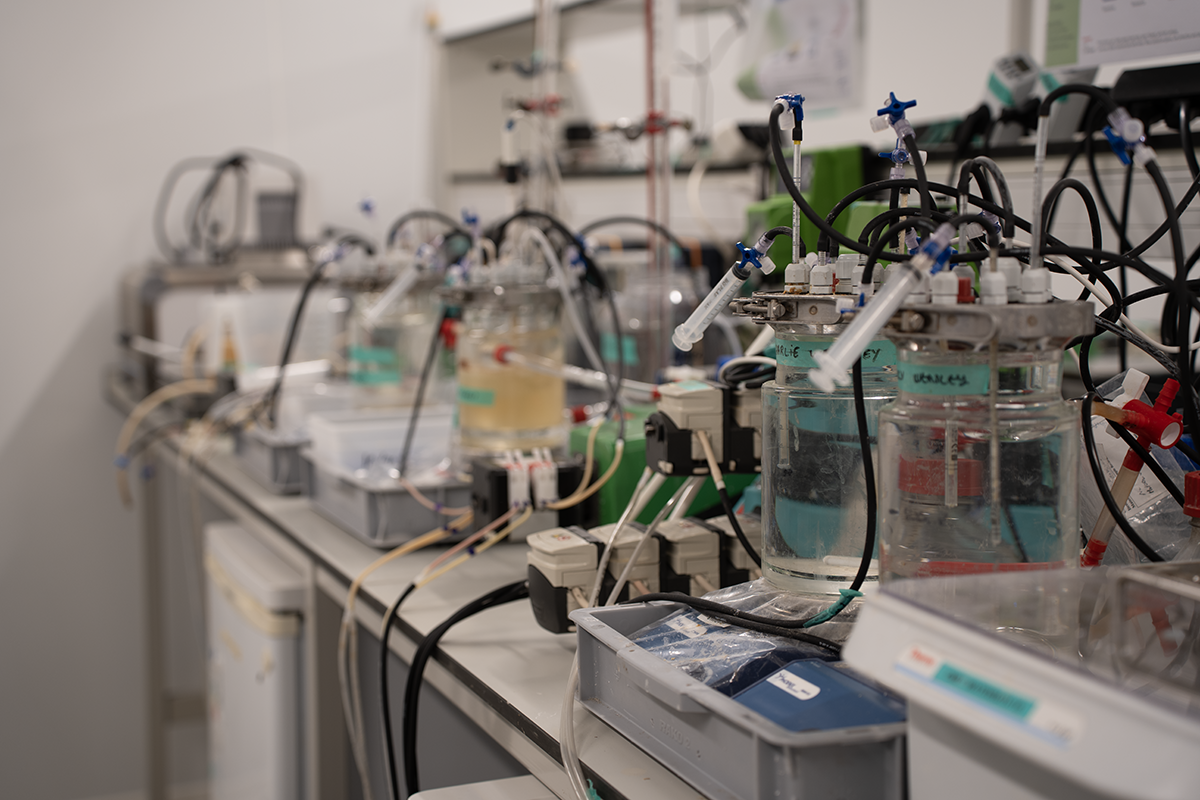
High production rates can be achieved in granular bioprocesses, where the microbial community grows as a dense, self-aggregating biofilm that is retained in the reactor. Such granules are typically dominated by two functional groups: lactic acid bacteria and chain-elongating bacteria. Their individual physiology and the interactions between them, however, remain largely unknown. In this dissertation, we aimed to isolate and
characterised representatives of both groups, determining their growth kinetics and their tolerance to the product. This revealed two contrasting growth strategies, as well as an unexpectedly high caproic acid tolerance in lactic acid bacteria, which helps to explain their persistence in the process. Co-cultivation further showed that chain-elongating bacteria grow and produce caproic acid better in the presence of lactic acid bacteria, pointing towards mutualistic interactions between the two groups. Together, these findings improve the fundamental understanding of granular bioprocesses for caproic acid production, supporting their more rational design in the future.